Low Hanging SEO Fruit Finder
The keywords already ranking on page 2 are one nudge from real traffic. See them ranked by the visits they’d actually return — scored against your own click curve. Free scan, top 3 shown in full.
Run your free scan
Your top 3 opportunities worked in full — the page, the target, and the exact edits. Free.
Secure Google sign-in Read-onlyNo passwordNo signup
We only ever read your Search Console data — never write to your account — and you can revoke access anytime.
Free scan on your real Search Console data · a full worked example shown · no account, no card
- Your top 3 opportunities worked in full, free — the page, the target, and the exact edits
- Scored against your site’s own click-through curve, not a generic table
- One-time report from $9 — no subscription, no account, no card to scan
See what a scan returns — before you connect
No black box. The free scan reads your real Search Console data, keeps the keywords sitting in positions 4–30, and scores each against your own click curve — then works your top 3 in full with the page, the target, and the exact edits. Here’s a real sample.
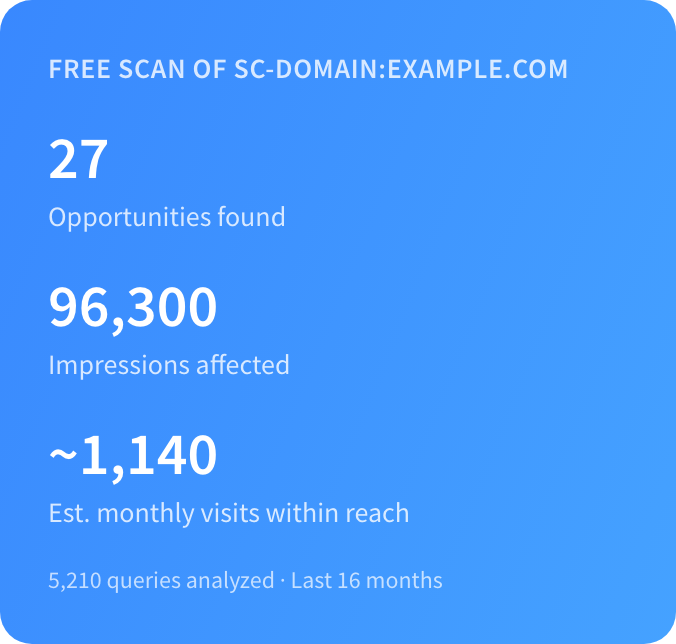
A real sample scan
- 27
- opportunities found
- 96,300
- impressions in reach
- ~1,140
- monthly visits within reach
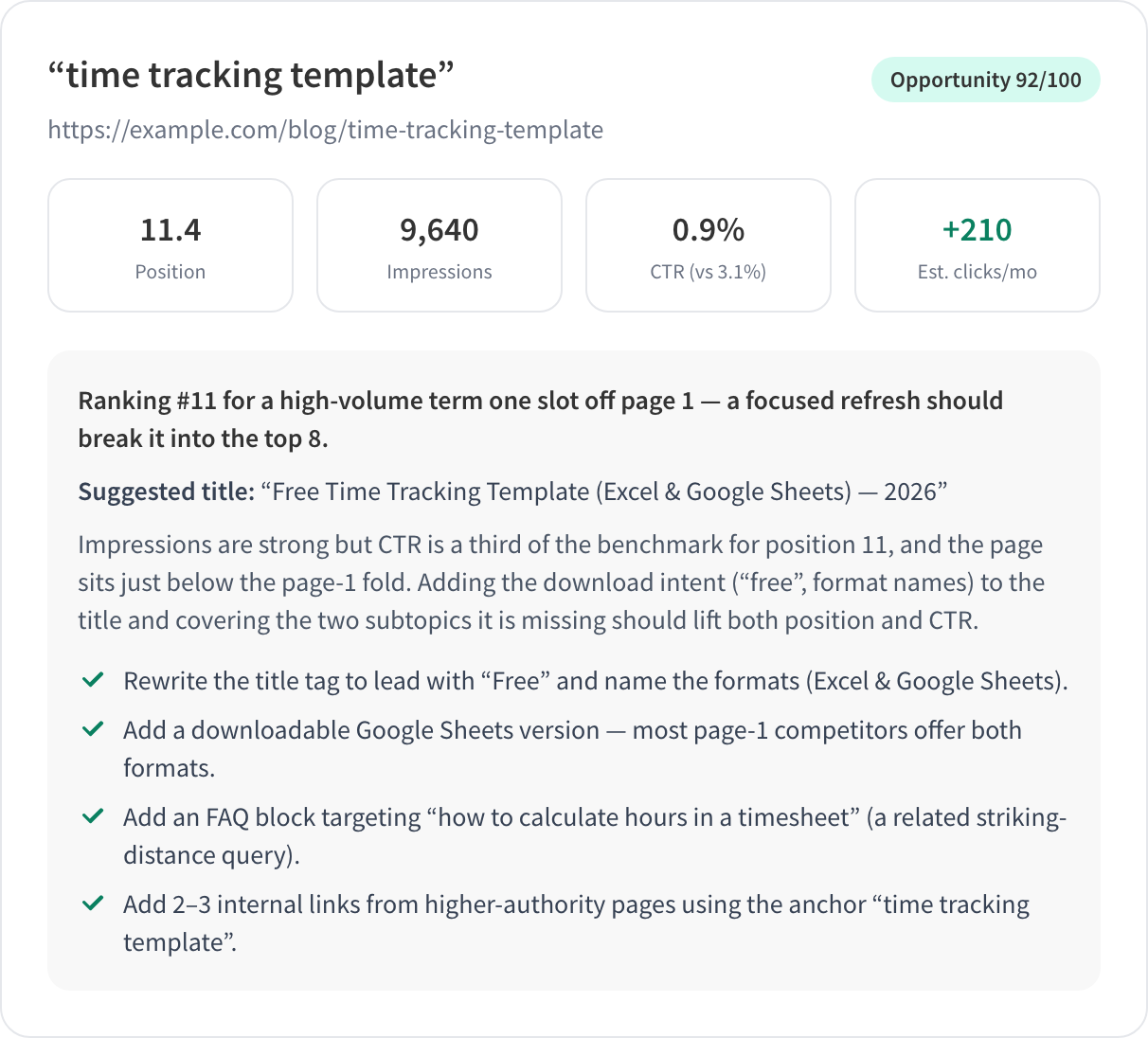
Worst offender, worked in full
“time tracking template” — opportunity 92/100, +210 clicks/mo within reach
This is a sample. Your scan shows your own site’s real numbers.
Sweet SEO fruit, ready to be harvested
The easiest wins in SEO are the rankings already sitting just off page 1. You have done the hard part — the page ranks — it is stuck at position 8, or 14, one nudge from real traffic.
Instead of scrolling Search Console hunting for them, this tool pulls every keyword in positions 4–30 and ranks them by the traffic a realistic gain would actually return — scored against your own click-through curve, not a generic table. Your top 3 come back free.
How it works
- 1
Connect Search Console
Sign in with Google, read-only. No account, no credit card — pick a verified property and you are scanning. The OAuth screen is the entire setup.
- 2
We score every opportunity
We pull your query data, keep the keywords sitting in positions 4–30, and score each one on how much traffic a realistic ranking gain would return — using your own site’s click-through curve, not a generic average.
- 3
See your quick wins, grouped and ranked
Your top 3 opportunities come back in full, and every other keyword is sorted into four action buckets. Unlock the complete list with the recommended move for each.
What the report looks like
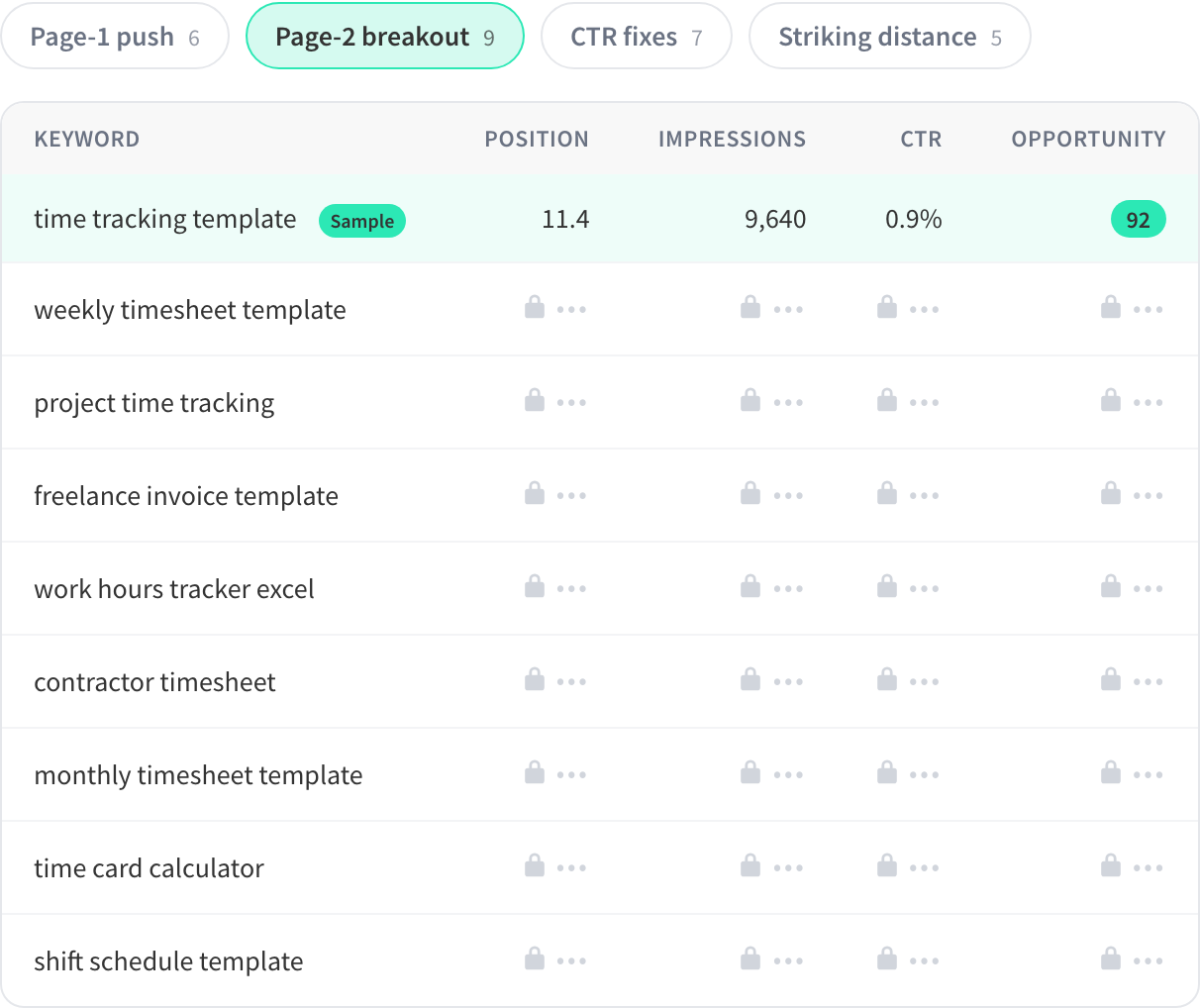
Every opportunity is a keyword, the page that ranks for it, where it sits today, and the single highest-leverage move. Here is what a report looks like.
How we score opportunities
A page-2 keyword is only a "quick win" if the traffic is real and the gain is reachable. The score weighs both, using signals from your own Search Console data instead of a generic keyword database.
We build your site’s own CTR curve
How many clicks a position earns varies wildly by site and query type. Where you have enough top-ranking keywords, we compute your property’s actual click-through-rate-by-position curve and score against that; where data is thin we fall back to published averages. That means the "clicks you are missing" figure reflects how your audience really behaves, not a 2018 industry table.
The opportunity score
Each keyword in positions 4–30, above the impression floor, gets scored as impressions × (expected CTR at the target position − current CTR) × feasibility. In plain terms: how much traffic is on the table, weighted by how reachable it is.
Feasibility decays with distance
A keyword at position 6 is far more winnable than one at position 28 with the same impressions, so feasibility decays the further a keyword sits from page 1. This keeps the report honest — it surfaces the nudges you can actually land first, not vanity keywords that would take a rewrite and six months.
Four action buckets
Every opportunity is sorted into the bucket that tells you what to do with it:
- Page-1 push (positions 4–10): your biggest wins — on-page tweaks plus a few internal links usually do it.
- Page-2 breakout (positions 11–20): needs more content depth and stronger internal linking.
- CTR fixes (top-5 rankings earning below your own CTR curve): the ranking is there but the title and meta are under-selling it — rewrite them.
- Striking distance (positions 21–30): a watchlist, each with the single highest-leverage action to move it.
Why not just sort GSC by position?
You can filter Search Console to positions 4–30 yourself. The difference is what happens after the filter.
| This tool | Manual GSC analysis | Crawl-based checkers | |
|---|---|---|---|
| Data source | Your real Search Console impressions, clicks and positions | Same data — filtered and sorted by hand | A crawl or a third-party keyword index; not your GSC clicks |
| Ranks by real upside | Opportunity score using your own CTR curve + feasibility | You eyeball position and impressions | Generic difficulty/volume scores, not your traffic |
| CTR-fix detection | Flags top rankings earning below your own click curve | Only if you build the curve yourself | Not available — no access to your CTR |
| Tells you what to do | Four action buckets + the highest-leverage move per keyword | You decide | A list of keywords, no next step |
| Internal-link suggestions | Sourced from your own pages that rank for related queries | Manual detective work | Generic, if offered at all |
| Time to result | Under a minute | An afternoon in spreadsheets | A crawl plus interpretation |
Frequently asked questions
What are low-hanging-fruit keywords?
Low-hanging-fruit keywords are searches you already rank for on page 2 or the bottom of page 1 — usually positions 4 to 30 — where a small improvement could move you up into real click territory. The ranking already exists, so the effort to gain traffic is far lower than starting a new page from scratch.
How does the low-hanging fruit finder work?
We read your Search Console data, keep the keywords in positions 4–30 that get real impressions, and score each on how much traffic a realistic ranking gain would return — factoring in your own click-through curve and how reachable the gain is. The result is a ranked list of the fastest wins, not just everything on page 2.
Is the finder free?
The scan is free and runs on your real data — you always see your total opportunity count, the estimated monthly traffic on the table, and your top 3 opportunities worked out in full. A one-time fee unlocks the complete list, grouped into buckets, with a recommendation for each keyword.
How is an opportunity scored?
The score is impressions × (expected CTR at the target position − your current CTR) × feasibility, where feasibility decays the further a keyword sits from page 1. It rewards keywords with real traffic on the table and a genuinely reachable gain, and it uses your site’s own CTR curve where the data supports it.
What are the four buckets?
Page-1 push (positions 4–10) — your biggest, easiest wins. Page-2 breakout (11–20) — needs more content depth. CTR fixes — top rankings under-earning versus your own click curve, usually a title/meta rewrite. Striking distance (21–30) — a watchlist with the single best move for each.
Do you store my Search Console data?
Your Google access is read-only and your tokens stay in an encrypted session only for the scan — never in our database. Scan results are cached encrypted for 7 days for instant re-runs, and paid reports are kept 90 days before automatic deletion. You can delete everything any time.
How is this different from Ahrefs or Semrush?
Ahrefs and Semrush estimate your rankings from a third-party index and sell a full subscription suite. This tool reads your actual Search Console data — the real positions and clicks Google records — scores opportunities against your own CTR curve, does one job, and charges once. No subscription.
How long does the scan take?
Usually under a minute. Very large properties are capped to the top queries by impressions so it stays fast, and the report notes when that happened.
What do I get when I pay?
The full report: every opportunity the scan found, grouped into the four buckets, each with a recommended move — title rewrites drafted against your real queries, content-gap notes, and internal-link suggestions sourced from your own site. Plus a CSV export, emailed and kept for 90 days.
What is your refund policy?
Refunds are automatic within 7 days, no questions asked. If the report did not earn its keep, ask for a refund and it is processed — no support ticket required.
Keep going
Keyword Cannibalization Checker
Before you push a keyword up, make sure two of your own pages are not fighting for it.
GuideSEO quick wins: the 15-minute playbook
Turn a page-2 ranking into page-1 traffic with the smallest possible change.
GuideHow to find low-hanging-fruit keywords
What makes a keyword "low-hanging", and the signals that separate a real win from a dead end.
GuideHow to find Google ranking opportunities
Read your Search Console like an analyst and find the pages one nudge from more traffic.
Trusted by SEOs
“This is how search insight should look like — a real time saver when it comes to SEO.”
 Loukman Nacikfrom bounceless.io · bounceless.io
“I’ve finally found the tool to guide our content marketing and linking strategy — the perfect tool.”
 Gary Assounfrom Biocoiff’ · Biocoiff’
Find your low-hanging fruit in one scan.
Free scan on your real Search Console data, your top 3 opportunities worked out in full. Sign in with Google — read-only, no account, no card.